Narrative is not
context.
It is evidence.
Thatch is built on a methodological premise that most public health practice does not yet hold: that lived experience, rendered in narrative form, contains structured, extractable, decision-grade knowledge.
Thatch is interpretive training for institutional practice.
Where community knowledge disappears
Public health has a well-developed infrastructure for collecting community input. It does not have an equivalent infrastructure for using it.
Community health needs assessments, listening sessions, and participatory research processes generate significant qualitative data. That data is typically coded, themed, and summarized for reporting. At the end of that process, institutions have quotes and categories. They do not have evidence.
This pattern holds across geographies and planning contexts. The knowledge communities hold about structural conditions, including conditions that are racialized, spatialized, and unevenly distributed, rarely reaches decisions in a form that changes what gets prioritized or funded.
Closing this gap requires a different methodology, not better engagement. Thatch provides that methodology.
What makes narrative
rigorous
Narrative carries epistemic content. When someone describes what is happening in their neighborhood, how their body has changed, or what their community stopped doing after a particular event, they are not providing anecdote. They are providing situated knowledge with causal, temporal, and structural dimensions.
Treating narrative as evidence does not mean treating it as equivalent to all other evidence. It means recognizing that narrative contains information that quantitative data cannot hold, and that this information is analyzable, structured, and useful for institutional decision-making when handled through the right framework.
Traditional qualitative research methods are designed to produce academic insight. They are not designed to produce institutional intelligence. This distinction matters for how narrative is collected, analyzed, and presented.
SBEF is built from traditions that have long understood narrative as knowledge.
The Story-Based Evidence Framework emerged through years of public health practice, facilitation, and interpretive work inside institutions tasked with making decisions about communities they often struggle to fully hear. But the framework did not emerge from practice alone. It was shaped by intellectual and community traditions that long preceded it — particularly Black-led traditions that have always understood narrative as knowledge. My formation in Africana Studies at San Diego State University and in public health at Charles R. Drew University grounds this work in two specific intellectual traditions. SBEF also emerged from participatory and community-rooted practice — from repeatedly witnessing institutions collect stories while lacking the interpretive infrastructure to translate those stories into decisions, priorities, and action.
The work of Camara Phyllis Jones is foundational to how SBEF understands systems, inequity, and institutional responsibility. Her insistence that racism functions structurally — not merely interpersonally — shaped how I learned to think about public health evidence itself: what institutions are trained to measure, what they routinely fail to interpret, and how inequity becomes normalized through systems that appear neutral.
SBEF also draws from Black feminist traditions that challenged the assumption that legitimate knowledge must be detached, impersonal, or institutionally sanctioned. Thinkers including Patricia Hill Collins and Saidiya Hartman helped establish lived experience, memory, and situated knowledge as rigorous ways of understanding social reality. This lineage informs SBEF's insistence that narrative is not supplemental to evidence, but a mode of evidence itself.
The literary work of Toni Morrison has also shaped how I think about interpretation. Morrison's attention to memory, silence, rupture, and the social life of history demonstrates how narrative can reveal structures formal institutional language often obscures. This orientation informs both SBEF and my broader narrative work, including A Mercy in the Telling. It is also why Thatch hosts literary cohorts as part of its practice — reading Morrison together with public health practitioners is methodology training, not adjacent enrichment.
The Story-Based
Evidence Framework
SBEF is a structured method for extracting decision-grade intelligence from community narrative. It was developed through practice across multiple public health planning contexts and is designed for institutional use.
The framework organizes narrative evidence across four analytical layers: temporal (what happened and in what sequence), spatial (where and how geography shapes experience), relational (who holds what knowledge and in what contexts), and structural (what systems and policies appear in the account). Within these layers, SBEF identifies ten evidence categories that can be mapped to institutional decision points.
The result is not a summary. It is an evidence brief: structured, sourced, and written in the register institutions use to make decisions.
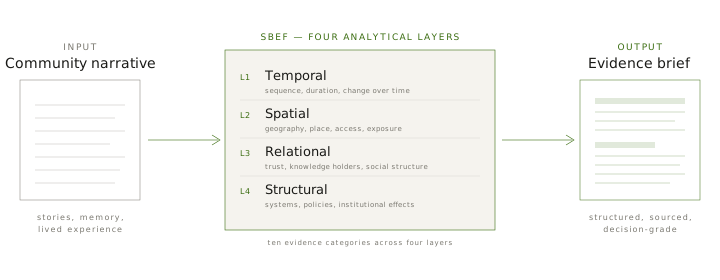
Sequence, duration, and change over time as described in community narrative. When things began. What preceded what.
Geographic and environmental knowledge embedded in lived experience. How place shapes access, exposure, and behavior.
Social structure as it appears in narrative. Who knows what. Who holds trust. How information and resources actually move through a community.
Systems, policies, and institutions as they appear in community accounts. The gap between intended and experienced policy effects.
Not qualitative research.
Institutional intelligence.
Traditional qualitative methods are designed to generate theory. SBEF is designed to generate decision support. The outputs look different. The analysis process is different. The audience is different.
Where qualitative research produces findings that require interpretation, SBEF produces evidence briefs that map directly to the questions institutions are already asking: Where should resources go? What populations are underserved? What are the structural drivers of this disparity? What does the community know that our data does not yet show?
This is also not a replacement for community engagement. Engagement produces voice. SBEF translates voice into intelligence. Both matter. They are not the same work, and Thatch does not position itself as one or the other. It is what makes engagement consequential.
While much of this work has been developed in public health settings, the underlying problem and the method used to address it extends to any institution working to translate lived experience into decision-making. This work is designed to hold under shifting language, priorities, and political conditions.
See how Thatch applies SBEF